Read-Aloud Maths – Survey

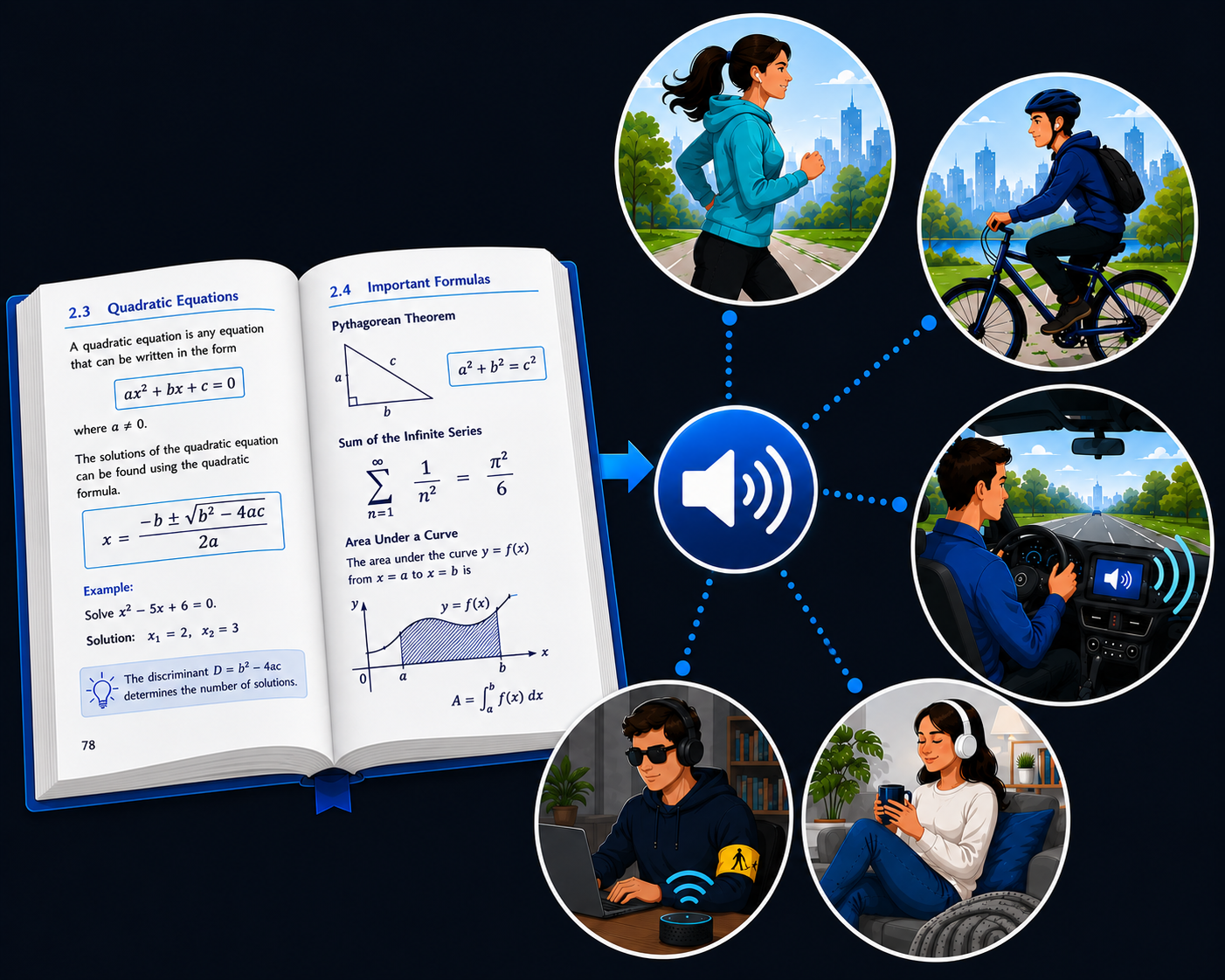
A textbook full of formulas and its loudspeaker output to listeners that jog, that bike, that drive, that rest, that listen behind sunglasses. Generated by OpenAI's chatbot. This survey aims to understand how mathematical content can be effectively converted into speech and used for learning. Your responses will help improve accessibility and learning experiences.

Data is collected on a server of the IU in Europe programmed by us, on a virtual machine where only the project team has access. All answers are anonymized before being analyzed.

en de


SECTION 1: background

Q1. What is your role?

Q2. In which field are you studying/teaching?


Q3. Do you have any visual impairment?


SECTION 2: Familiarity with Mathematics

Q4. How familiar are you with the following topics?

Not familiar at allVery familiar
Multiplication, division, addition, subtraction
Polynomials & fractions:
Functions, derivatives & integrals:
Matrices & vectors:
Geometry:
Physics:
Chemistry:
Statistics & probability:
Logic & set theory:

SECTION 3: Use of Read-Aloud Tools

Q5. How often do you use read-aloud (text-to-speech) functions in average?

Q6. Which read-aloud tools do you use? (several choices possible)


SECTION 4: General Audio Usage

Q7. Which audio formats do you use for learning? (several choices possible)


SECTION 5: Usage Situations

Q8. In which situations do you use audio? (several choices possible)


SECTION 6: Understanding Mathematical Audio

Q9. When using read-aloud, does the read-aloud tool express mathematical formulas?

Q10. When the read-aloud includes mathematical formulas are they understandable?

very difficultvery easy

Q11. Which aspects are difficult to understand when listening to mathematical content? (several choices possible)

Q12. What is the length of a formula that is understandable when read-aloud?


SECTION 7: Improvement

Q13. What would improve your understanding of spoken mathematical text with formulas? (several choices possible)


SECTION 8: Participation

Q14. Would you be willing to participate in experiments of read-aloud maths?


SECTION 9: Feedback